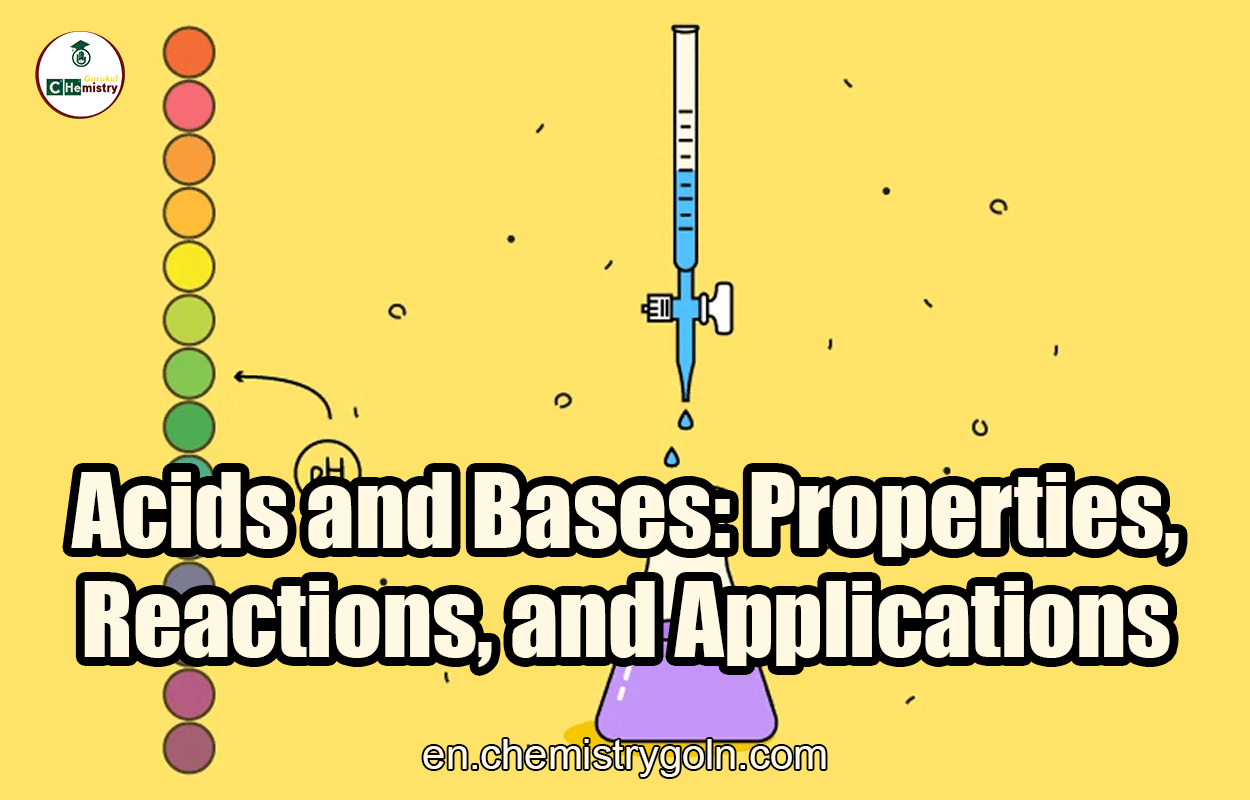
Acids and bases are two fundamental classes of chemical substances that play a crucial role in both our everyday lives and various industrial processes. From the food we eat to the cleaning products we use, acids and bases are everywhere. They are also essential in biological systems, manufacturing, and environmental processes. This article explores the nature of acids and bases, their properties, common reactions, and their wide range of applications.
Acids and Bases
What Are Acids and Bases?
Acids are substances that can donate a proton (H⁺ ion) when dissolved in water. They typically have a sour taste, can conduct electricity, and react with metals to produce hydrogen gas. Acids turn blue litmus paper red, indicating their acidic nature. Common examples include hydrochloric acid (HCl), sulfuric acid (H₂SO₄), and citric acid found in citrus fruits.
Bases are substances that can accept a proton or donate a hydroxide ion (OH⁻) when dissolved in water. They usually have a bitter taste and a slippery feel. Bases turn red litmus paper blue. Common examples of bases include sodium hydroxide (NaOH), commonly known as lye, and ammonia (NH₃).
Properties of Acids and Bases
1. pH Scale: The pH scale, ranging from 0 to 14, measures the acidity or basicity of a solution. A pH of 7 is neutral, meaning the substance is neither acidic nor basic (pure water). A pH less than 7 indicates an acidic solution, while a pH greater than 7 indicates a basic solution. Strong acids have a pH close to 0, and strong bases have a pH close to 14.
2. Ionization:
– Acids: When acids dissolve in water, they ionize to release hydrogen ions (H⁺). For example, hydrochloric acid (HCl) ionizes as follows:
\[
HCl \rightarrow H^+ + Cl^-
\]
– Bases: Bases ionize in water to release hydroxide ions (OH⁻). For example, sodium hydroxide (NaOH) dissociates as:
\[
NaOH \rightarrow Na^+ + OH^-
\]
3. Strength:
– Strong Acids and Bases: Strong acids and bases ionize completely in water. Examples of strong acids include hydrochloric acid (HCl) and sulfuric acid (H₂SO₄). Strong bases include sodium hydroxide (NaOH) and potassium hydroxide (KOH).
– Weak Acids and Bases: Weak acids and bases ionize partially in water. Examples of weak acids are acetic acid (CH₃COOH) and carbonic acid (H₂CO₃). Weak bases include ammonia (NH₃) and bicarbonate (HCO₃⁻).
4. Reactivity:
– Acids react with metals to produce hydrogen gas and a salt. For example:
\[
2HCl + Zn \rightarrow ZnCl_2 + H_2
\]
– Bases react with acids in a neutralization reaction to form water and a salt. For example:
\[
NaOH + HCl \rightarrow NaCl + H_2O
\]
Common Reactions Involving Acids and Bases
1. Neutralization: A reaction between an acid and a base produces water and a salt. This reaction is fundamental in various applications, including antacid tablets for stomach relief and wastewater treatment.
\[
HCl + NaOH \rightarrow NaCl + H_2O
\]
2. Acid-Base Titration: This is an analytical technique used to determine the concentration of an acid or base in a solution by reacting it with a base or acid of known concentration. The point at which the reaction is complete is called the equivalence point, often indicated by a color change from an added indicator.
3. Buffer Solutions: Buffers are solutions that can resist changes in pH when small amounts of acid or base are added. They are crucial in maintaining the pH of blood and other biological fluids.
A common buffer system is the carbonic acid-bicarbonate buffer system in blood:
\[
H_2CO_3 \rightleftharpoons H^+ + HCO_3^-
\]
4. Electrolyte Behavior: Acids and bases can conduct electricity when dissolved in water due to the movement of ions. Strong acids and bases are good conductors, while weak acids and bases are poor conductors.
Applications of Acids and Bases
1. In Industry:
– Acids: Sulfuric acid is used in battery production, fertilizer manufacturing, and chemical synthesis. Hydrochloric acid is used in metal processing and cleaning.
– Bases: Sodium hydroxide is widely used in soap making, paper production, and chemical manufacturing. Ammonia is used in fertilizers, cleaning products, and refrigeration.
2. In Daily Life:
– Acids: Vinegar (acetic acid) is used in cooking and food preservation. Citric acid is used in beverages and as a natural preservative.
– Bases: Baking soda (sodium bicarbonate) is used in baking, cleaning, and as an antacid. Toothpaste contains mild bases to neutralize acids in the mouth.
3. In Medicine:
– Acids: Acetylsalicylic acid (aspirin) is a common pain reliever. Stomach acid (hydrochloric acid) aids in digestion.
– Bases: Antacids containing magnesium hydroxide or aluminum hydroxide neutralize excess stomach acid, providing relief from heartburn.
4. In Environmental Science:
– Acid Rain: Acid rain, caused by the release of sulfur dioxide and nitrogen oxides into the atmosphere, can damage ecosystems, buildings, and aquatic life. It highlights the importance of controlling acid emissions.
– Soil Treatment: Lime (calcium hydroxide) is used to neutralize acidic soils, improving crop yields.
Acids and bases are integral to many aspects of life, from the food we eat to the industries that produce essential goods. Understanding their properties, reactions, and applications allows us to harness their power for beneficial purposes, while also mitigating potential hazards associated with their misuse. Whether in a laboratory, a factory, or a kitchen, the principles of acids and bases are foundational to science and everyday life.